
Commercial Masonry Restoration: What Twin Cities Property Managers Should Know
If you manage a masonry building in the Twin Cities, one line summarizes this whole guide: masonry problems are water problems, and water problems compound in a climate with 80 to 100 or more freeze-thaw cycles a year. The published industry numbers agree: targeted commercial repairs commonly start around $5,000, full-elevation tuckpointing runs roughly $15,000 to $80,000 per elevation, and deferred maintenance ends up costing 5 to 10 times the original scope once deterioration reaches structural elements.
The good news is that masonry deterioration is slow, visible and manageable when someone is watching for it. Here is what to watch, what things cost, and how the work actually runs on an occupied building.
The Failure Points That Show Up First
Parapets. The wall section above the roofline takes weather on three sides and no heat from the building. Industry sources are blunt that parapets fail before any other masonry element. Cracked copings, open joints and leaning parapet sections are top-priority findings because they feed water into everything below and, unrepaired, become falling hazards.
Steel lintels and shelf angles. The steel over windows and doors rusts, and rust expands. That expansion, called oxide jacking, cracks and displaces the brick around it. Rust staining below an opening and horizontal cracks above one are the classic tells. Lintel replacement runs a few thousand dollars per opening in published figures, and it must happen before the surrounding wall is repointed, not after.
Mortar joints at scale. The same joint failure a homeowner sees on a chimney happens across thousands of square feet of elevation. Commercial tuckpointing is priced by the square foot, roughly $5 to $25 and up, with height and access driving the spread.
Stone banding, sills and copings. Water tracks along stone elements and works the joints around them. A shadow line under a stone band or a cracked sill is water announcing its route into the wall.
What the Numbers Look Like
| Scope | Published range |
|---|---|
| Targeted commercial repairs | from ~$5,000 |
| Commercial tuckpointing | $5 to $25+ per sq ft |
| Facade tuckpointing, per elevation | $15,000 to $80,000 |
| Access equipment share of project | 15 to 25% |
| Deferred-maintenance multiplier | 5 to 10x |
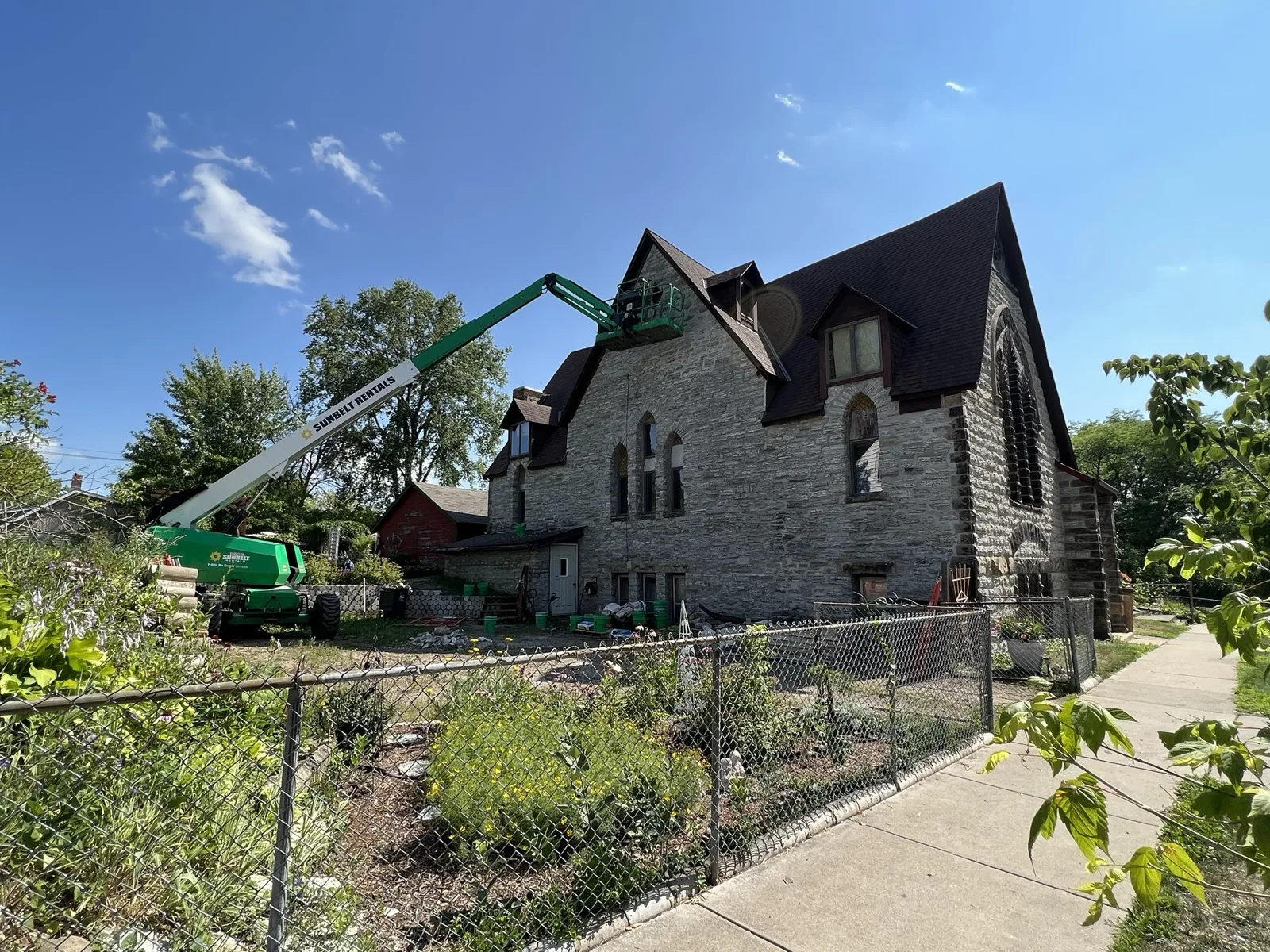
Two structural facts hide in that table. First, access is a huge share of cost on anything tall: scaffolds, swing stages and lifts have to be mobilized regardless of how much wall gets fixed. That is exactly why combining scopes into one mobilization, doing the lintels, the repointing and the parapet in one staged project, beats three separate small contracts. Second, the multiplier is real: joints that could have been repointed become brick replacement, brick replacement becomes section rebuilds, and every stage costs multiples of the one before it. Every line in that table is broken out by the unit, per square foot, per opening and per linear foot, in our commercial masonry restoration cost guide.
How Restoration Runs on an Occupied Building
A competent restoration contractor treats your operations as part of the scope:
- Assessment on the wall. Not a drive-by. Someone gets on the elevation, photographs the failures, and maps how far deterioration runs.
- A written, prioritized scope. Must-fix separated from can-wait, so a board or owner can phase the work across budget cycles instead of facing one number.
- Sequenced execution. Entrances stay open, walkways below the work are protected, tenants get notice, and the site gets cleaned daily.
- Closeout on the wall. A punch-list walk with the manager or owner before the equipment leaves, because remobilizing later is the expensive way to finish a job.
That sequence is how we run commercial restoration at Metro Masonry, on churches, schools, apartment buildings, storefronts and industrial walls across the metro.
A Practical Watch List for Your Properties
Walk your buildings once a year, in spring after the freeze, and photograph anything on this list:
- Stair-step cracks through mortar joints
- White efflorescence staining after rain
- Brick faces flaking or popped off
- Rust stains at window and door heads
- Open or washed-out joints at parapets and copings
- Mortar sand collecting at the base of walls
- Interior leak complaints on top-floor units after storms
None of these means the building is in trouble today. All of them mean water has a route, and in this climate a route becomes damage on a schedule. Photos of any of them are enough for us to give you a first read, at no cost, on whether it is a this-season item or a next-budget item.
The cheapest restoration project is the one scoped before winter gets another season on the wall. If you manage property in Minneapolis or anywhere in the metro, call and we will put eyes on it.