
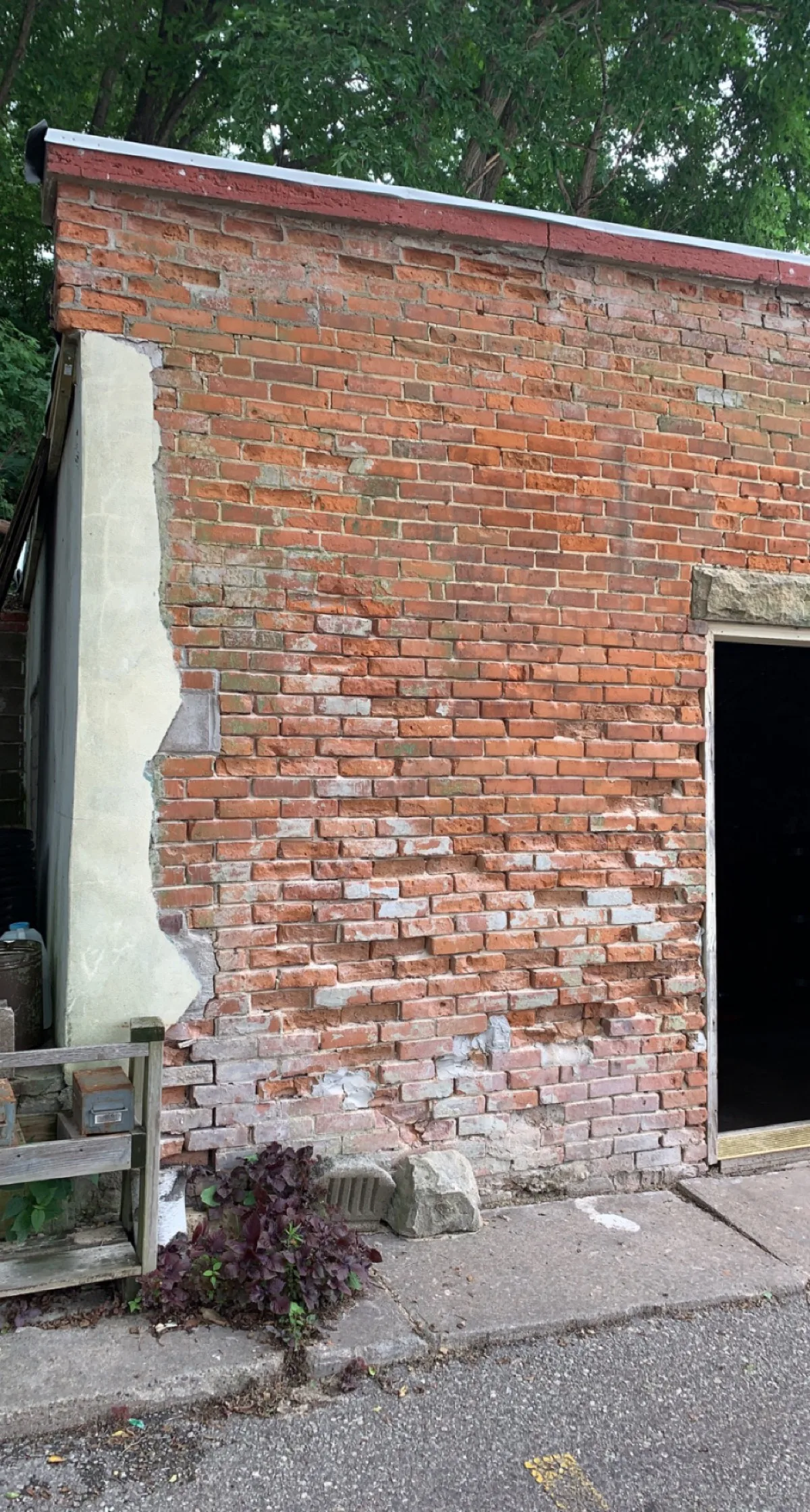
Why Your Brick Is Flaking Apart: Spalling and the Minnesota Freeze-Thaw Cycle
If brick faces around your house are cracking, flaking or popping off entirely, that is spalling, and the cause is almost always the same: water got inside the brick and winter did the rest. In a climate that runs 80 to 100 or more freeze-thaw cycles a year, the Twin Cities is close to a worst-case environment for it.
The short version of what to do: fix the water path first, then replace the damaged brick with matched units. Published costs run roughly $50 to $150 per brick for individual replacement and $500 to $2,000 for typical sections. The long version, including why it happens and when it stops being a small job, is below.
What Is Actually Happening to the Brick
A fired brick has a hard outer face and a softer, more porous interior. When water gets inside and the temperature drops, the water freezes and expands, pushing outward from within. The face is the part that loses. One or two cycles do nothing visible. Dozens of cycles a winter, year after year, fracture the face until it separates and falls off.
Once the face is gone the situation gets worse, not stable. Masonry testing standards identify absorption rate as the key variable in freeze-thaw durability, and the exposed interior absorbs water much faster than the fired surface did. A spalled brick is a brick on an accelerating schedule, and it shares its water with its neighbors.
Where the Water Gets In
Spalling is the symptom. The water path is the disease, and it is usually one of these:
- Failed mortar joints. Joints that have cracked, recessed or gone soft hold water against the brick. This is the most common entry point, and the reason spalling and tuckpointing so often show up on the same wall.
- A failed crown, cap or coping. Chimneys and parapets take water from the top. A cracked crown or missing cap feeds the whole stack, which is why chimney spalling concentrates near the top.
- Grade, splash and salt. Soil piled against brick, downspouts dumping at the wall, and deicing salt working on porch piers and foundation courses all saturate the bottom of a wall.
- Paint and sealers that cannot breathe. Film-forming coatings trap moisture inside the wall. When it freezes, the only way out is through the brick face. Bubbling paint on brick is often spalling in progress underneath.
- A previous repair done with the wrong mortar. Hard modern mortar on soft older brick transfers stress into the brick instead of the joint. The rule in the trade is that mortar must always be softer than the brick it joins, and older Minneapolis housing stock is exactly where that rule gets violated by quick repairs.
What the Repair Actually Involves
Done right, spalling repair is a sequence, not a patch:
- Find and fix the water path. Repoint the failed joints, recast the crown, cap the flue, correct the grade or downspout. Skipping this step means the new brick fails the same way the old one did.
- Cut out the failed units. Each spalled brick is cut out cleanly, protecting the neighbors.
- Match and replace. Replacement brick is matched on size, color range and texture, set with compatible mortar, and struck to the original joint profile. On repairs done well you lose track of which bricks are new.
- Repoint the surrounding area. The joints around the damage are usually what let the water in, so they get renewed as part of the scope, not as an upsell.
What It Costs, and Why Waiting Multiplies It
| Scope | Published range |
|---|---|
| Individual brick replacement | $50 to $150 per brick |
| Small section (roughly 10 to 30 bricks) | $500 to $2,000 |
| Larger spalled areas | $3,000 to $8,000+ |
| Minor masonry repairs generally | $500 to $1,000 |
The pattern the industry data documents is the one we see on walls: a 10-brick problem discovered in spring is commonly a 20 to 30 brick problem one winter later, because the exposed interiors drink water all season. Chimney work also prices 20 to 30 percent above ground-level work because of access. The cheapest version of spalling repair is always this year’s version.
When It Is Bigger Than Spot Repair
Scattered spalling with a clear cause is a repair job. Spalling spread across a whole elevation, bowed sections, step cracking through multiple courses, or brick you can move by hand are structural signals, and the right response is an assessment, not a bucket of mortar. That is brick repair and rebuild territory on a house, and a restoration scope on a commercial building.
Either way, the first step costs nothing: send us photos of what you are seeing. We will tell you honestly whether it is a handful of bricks, a wall that needs a season of attention, or nothing urgent at all. Metro Masonry repairs and rebuilds brick across Minneapolis and the Twin Cities metro, and matching the repair to the original wall is the standard we hold.