
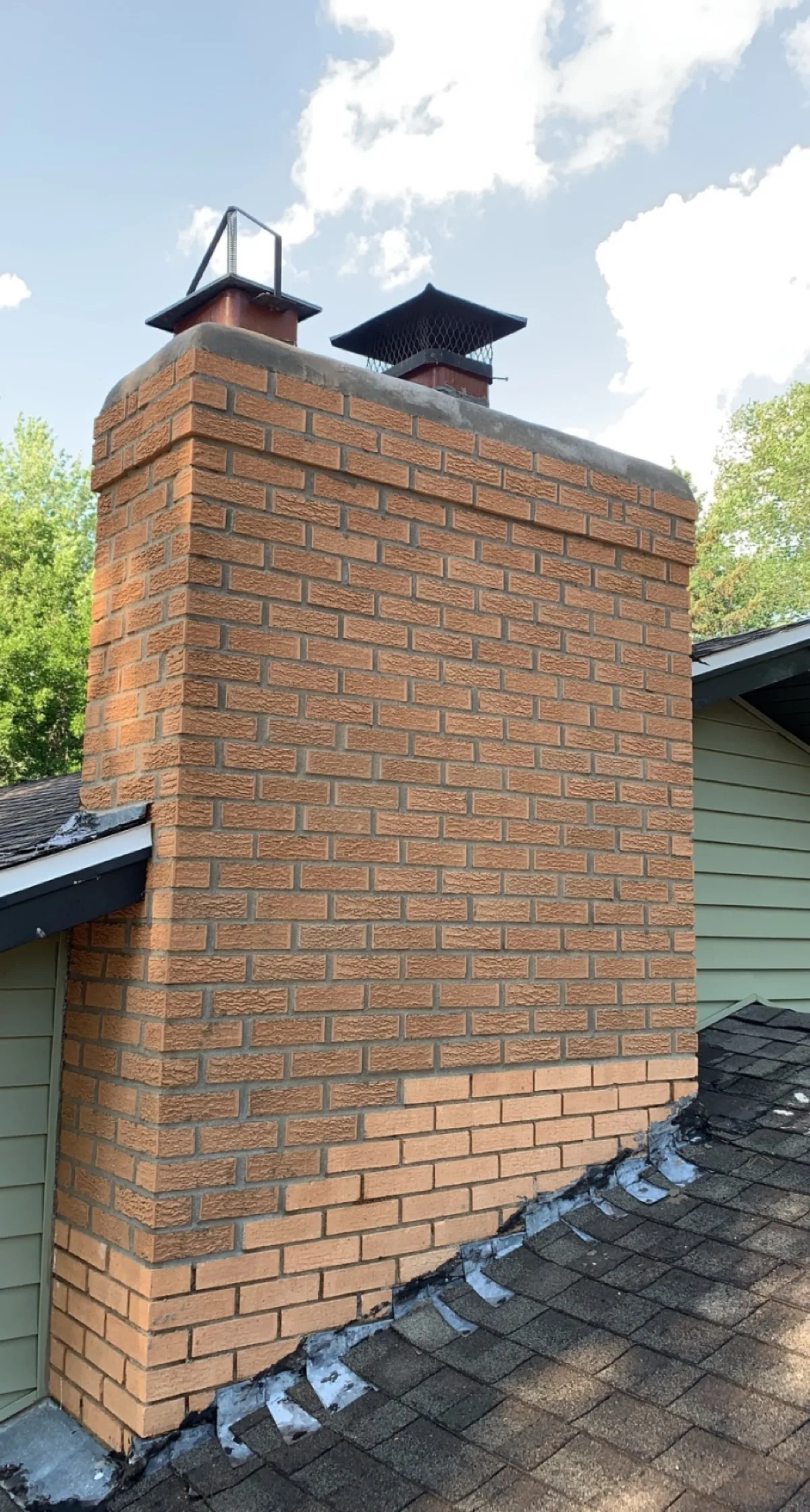
How Much Does a Chimney Liner Cost in Minnesota, and When Is One Required?
Published 2026 data puts chimney liner installation at $1,500 to $4,000 on average. A stainless steel liner runs $900 to $3,800 installed, clay tile $2,000 to $3,500, and cast-in-place $2,000 to $7,000. On the code side, the Minnesota Residential Code states that masonry chimneys shall be lined, so an unlined flue serving a furnace, water heater or fireplace is a repair item, not a preference.
Plenty of Twin Cities chimneys fall into that category. Houses built before the 1920s often went up with no liner at all, and the clay tiles in chimneys from the 1920s through the 1980s have taken decades of thermal shock and 80 to 100 freeze-thaw cycles a year. This guide covers what each liner costs, what relining an old flue adds, and when Minnesota rules and safety standards say you need one. It is the liner half of our chimney repair and liner systems work.
What does each type of chimney liner cost?
| Liner type | Installed range (published 2026) | Typical lifespan | Notes |
|---|---|---|---|
| Aluminum | $625 to $2,250 | 5 to 15 years | Gas appliances only |
| Stainless steel, 304 grade | $900 to $3,800 | 15 to 25 years | The standard reline |
| Stainless steel, 316Ti grade | $2,500 to $5,000 | 25 to 50+ years | Rated for every fuel |
| Ceramic coating repair | $2,000 to $4,500 | 10 to 20 years | Seals sound clay tiles |
| Clay tile | $2,000 to $3,500 | 50+ years | Rarely retrofitted |
| Cast-in-place | $2,000 to $7,000 | 30 to 50+ years | Reinforces the chimney |
Materials alone run $6 to $15 per foot for clay, $20 to $90 per foot for stainless, and $40 to $120 per foot for cast-in-place. Labor runs $500 to $1,500 for a stainless install and $800 to $3,000 for cast-in-place. Insulation wrap on a stainless liner adds $300 to $800, and it is not optional for performance or for the manufacturer’s warranty.
Stainless steel is the answer for most relines because it drops into the existing flue without opening the chimney wall, works with every fuel when the grade matches the appliance, and installs in a day. Cast-in-place costs more and takes two to three days, but it is the right tool when the masonry itself has started to fail. The poured liner bonds to the brick and reinforces the whole stack from the inside, which can save a chimney that would otherwise need a rebuild.
What does relining an existing chimney add?
Relining costs $1,200 to $4,600 on average in published figures. The difference from a fresh install is removal. Pulling an old steel liner adds $250 to $800. Breaking out cracked clay tiles adds $500 to $2,500, because the tiles have to come out through the flue in pieces.
Ask about leaving the old clay in place. Where the tiles are cracked but not collapsed, a new stainless liner often fits inside them, and that skips the most expensive line on the estimate. Chimneys with offsets or bends may need a flexible liner or a cast-in-place liner instead of a rigid one. A camera inspection before the quote tells the installer which case yours is.
When is a chimney liner required in Minnesota?
The code text is short. Section R1003.11 of the Minnesota Residential Code, which is Minnesota Rules Chapter 1309, reads: masonry chimneys shall be lined, and the lining material shall be appropriate for the type of appliance connected, in accordance with the appliance listing and the manufacturer’s instructions. Listed liner systems have to meet UL 1777.
In practice, four situations bring that rule to your chimney:
- A new masonry chimney. It is built lined, period.
- A new or replacement appliance. A high-efficiency furnace, a new water heater, a gas insert or a wood stove insert all come with venting instructions from the manufacturer, and the code ties the liner to those instructions. An old clay flue sized for a 1960s furnace is usually too large for a modern one, and the cooler exhaust condenses inside it and eats the tiles.
- A damaged liner. Cracked, shifted or missing tiles let heat and gases reach the framing next to the chimney. Once an inspection finds that, the chimney should not be used until it is relined.
- An unlined flue put to use. Pre-code chimneys were never required to add a liner while they sat idle, but venting a wood-burning appliance through bare brick is exactly what the liner rule exists to prevent.
Existing chimneys are not opened up to check for compliance, and cities apply the rule at permit time. Confirm the specifics for your situation with your city’s building department before the work is scoped.
How do you know if an old chimney needs a liner?
The industry standard for chimney inspections, NFPA 211, calls for a Level 2 inspection when a house is sold, when the appliance or fuel changes, and after any chimney fire or storm damage. A Level 2 includes a video scan of the flue, which is the only reliable way to see cracked tiles. Published costs run about $200 to $600.
Signs that point to a liner problem before anyone puts a camera down the flue:
- Pieces of clay tile in the firebox or at the cleanout
- White powder or staining inside the flue
- Rust on the damper or the firebox
- Smoke or a burnt smell in the room when the fireplace runs
- A chimney with no visible tile at the top, which usually means no liner at all
Water causes much of this damage. A failed crown or an open flue lets rain straight down onto the tiles, and Minnesota winters freeze it there. That is why a liner estimate usually pairs with the crown and cap work in our chimney repair cost guide.
Stainless or cast-in-place: which one for your chimney?
Start with the masonry, not the liner. If the chimney is structurally sound and only the flue has failed, an insulated stainless liner is faster, cheaper and just as safe. If the brick is loose, the joints are gone or the stack has started to lean, a cast-in-place liner can reline and reinforce it in one step. Past that point, the decision becomes repair or rebuild rather than which liner.
On grade, the two common stainless alloys are 304 and 316Ti. 316Ti is rated for every fuel and carries the longest warranties. The right grade depends on the appliance, and a good installer names it in writing on the estimate.
What moves the price?
- Height and pitch. A 30 foot flue costs more than a 15 foot one, and a steep roof adds setup.
- Number of flues. Many older Twin Cities chimneys carry two or three.
- Offsets and bends. They push the job toward a flexible liner or cast-in-place.
- Old liner removal. The biggest swing item, $250 to $2,500 depending on material.
- Insulation and top plate. Usually included on a stainless install; confirm it is.
- Access. Two-story and three-story chimneys need staging that a rambler does not.
Boiler stacks on apartment buildings and churches follow the same rules at a larger scale, and that work runs through our commercial masonry restoration process.
Get a real number
Ranges plan the budget. A camera down the flue and a look at the crown set the price. We inspect the chimney top to bottom, photograph what we find, and quote the liner with any crown, cap or repointing work as one written number. Call or text (320) 465-1161, or send photos through our contact page.