How Much Does Chimney Flashing Repair Cost in Minnesota?
Chimney flashing repair costs $300 to $1,800 on average, according to a published 2026 flashing cost guide. Another 2026 guide puts most jobs at $400 to $1,600, with a national average of $1,000. That second guide says flashing work on very large or stone chimneys can cost upwards of $2,000.
Those are national figures, and the scope of the job sets the price. A reseal fixes a lifted edge. A full reflash replaces the step, base and counter flashing. How we cut out failed counter flashing and set new metal is on our chimney flashing repair page.
Much of the local housing is old. In Minneapolis, 87,975 of 216,155 housing units date from 1939 or earlier. That count comes from the Census Bureau’s 2024 American Community Survey, and it works out to about 4 in 10.
What does each chimney flashing repair cost?
The guides below group the same work in different ways, so each row keeps its own source. All of them are 2026 figures.
| Job | Published range | Source |
|---|---|---|
| Sealant refresh, metal intact | $150 to $400 | a 2026 roofing contractor guide |
| Sealant or patching for small cracks or lifted edges | $200 to $500 | a 2026 flashing cost guide |
| Reseal of flashing that is built right and intact | $300 to $800 | a 2026 St. Louis roofing guide |
| Partial reflash, step or counter flashing only | $400 to $800 | a 2026 roofing contractor guide |
| Counter flashing replacement | $500 to $1,000 | a 2026 Massachusetts guide |
| Partial reflash, the apron or one side’s step flashing | $500 to $1,200 | a 2026 St. Louis roofing guide |
| Full reflash, step and counter flashing | $600 to $1,800 | a 2026 roofing contractor guide |
| Full reflash, new step, counter and apron flashing | $800 to $2,500 | a 2026 St. Louis roofing guide |
| Cricket installation on a wide chimney | $500 to $1,500 | a 2026 roofing contractor guide |
| Full reflash plus building and flashing a cricket | $1,500 to $3,500 | a 2026 St. Louis roofing guide |
Sealant is the cheapest fix, and it fits only metal that is still sound. The flashing cost guide says rusted metal, missing sections or water getting under the shingles can mean full replacement. The St. Louis guide adds a plain check. If there is no counter flashing, the fix is a reflash.
Counter flashing is the costly part to redo. The roofing contractor guide says re-embedding it tends to cost more than step flashing alone. The reason it gives is that the job requires repointing mortar joints.
Why does a masonry chimney cost more to reflash?
New flashing on a brick or stone chimney means cutting into the masonry. The flashing cost guide says contractors must cut into masonry to install new flashing properly. It says metal or prefabricated chimneys typically cost less to reflash. Natural stone is harder to work than soft manufactured veneer, and brick falls in the middle.
The Brick Industry Association’s Technical Note 19B describes the masonry side. Counter flashing goes into a mortar joint for 3/4 to 1 inch and is mortared solidly into the joint. It laps the base flashing below it by at least 3 inches. On a reflash, we cut out the old counter flashing and clean out the joint. The new metal is mortared in solid.
That labor drives the price. The flashing cost guide puts labor at 60 to 70 percent of a flashing repair. It says masons charge $50 to $125 an hour on average, and some contractors charge a flat rate instead.
What does flashing metal cost per linear foot?
| Metal | Cost per linear foot | Published lifespan |
|---|---|---|
| Aluminum | $5 to $10 | 15 to 20 years |
| Galvanized steel | $6 to $10 | Life of the roof, 25 to 30 years |
| Copper | $15 to $30 | 50 to 100 years |
The costs and the aluminum and copper lifespans come from a 2026 flashing cost guide. The galvanized steel lifespan comes from a 2026 St. Louis roofing guide.
With labor at 60 to 70 percent, the metal is the smaller part of most bills. The St. Louis guide calls galvanized steel the standard. It says copper looks better on a historic home and costs three to four times more.
Any metal has to meet a minimum. Minnesota Residential Code section R903.2.1 says metal flashing must be corrosion resistant and at least 0.019 inch thick. The code lists that thickness as No. 26 galvanized sheet.
What does the Minnesota code ask of chimney flashing?
Chapter 9 of the Minnesota Residential Code, Roof Assemblies, sets the rules. Section R903.2.1 calls for flashing at wall and roof intersections and around roof openings. Where a chimney comes through a roof, both apply.
Section R903.2.2 calls for a cricket or saddle on the ridge side of any chimney more than 30 inches wide. The width is measured perpendicular to the slope. The covering is sheet metal or the same material as the roof covering. Building a new cricket frame is roofing work.
Technical Note 19B says a cricket is flashed and counter flashed the same way as the chimney and roof joint. Its flashing at the roofline runs at least 4 inches under the roofing material. We flash and counter flash the cricket where a chimney has one.
Sections R905.2.8.3 and R905.2.8.4 cover asphalt shingle roofs. Flashing against a sidewall is continuous or step flashing, at least 4 inches high and 4 inches wide. Chimney flashing on a shingle roof goes in per the shingle manufacturer’s printed instructions.
The type changes the price. A second 2026 cost guide puts step flashing at $400 to $600 and continuous flashing at $800 to $1,000. One 2026 guide also notes that local codes might require permits and inspections, which add fees.
Which parts of the chimney flashing get replaced?
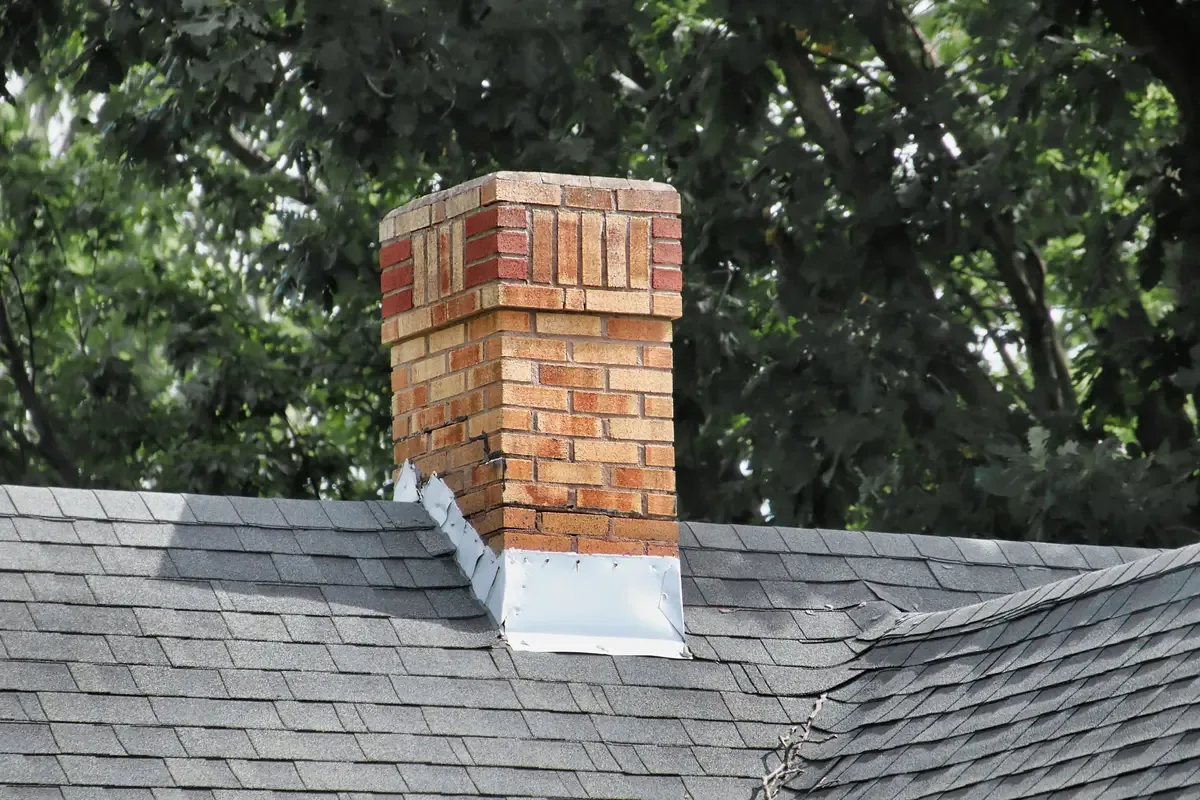
A partial job replaces the part that failed, and a full reflash replaces all of them. Step flashing is woven in with the shingles along each side. Base flashing runs across the front. Counter flashing laps over both, with its top edge in a mortar joint.
Technical Note 19B sets the overlaps. Base flashing runs at least 4 inches up the face of the chimney and along the roof. Flashing installed in sections laps the lower piece by at least 2 inches. All joints in the base and counter flashing are sealed.
If one side has rusted through, the St. Louis guide prices a partial reflash tied into the existing counter flashing. Its full reflash covers new step flashing, a groove cut in the mortar, new counter flashing and a new apron. We replace rusted, torn or loose step flashing and base flashing as the chimney needs it.
What moves chimney flashing prices in the Twin Cities?
Chimney size comes first. The flashing cost guide breaks its 2026 range out by size.
| Chimney size | Published range (2026 flashing cost guide) |
|---|---|
| Small | $300 to $1,200 |
| Mid-sized | $400 to $1,500 |
| Large | $500 to $1,800 |
Roof height and pitch come next. The flashing cost guide says steep roofs and multi-story homes need extra safety equipment and labor time. The St. Louis guide adds 20 to 40 percent for steep roofs that need staging. A 2026 Massachusetts guide adds 15 to 25 percent on two-story homes for scaffolding and safety setup.
Freeze and thaw cycles matter in Minnesota. The Massachusetts guide names counter flashing as the part that fails most often there. It says freeze and thaw cycling pulls counter flashing away from the mortar joints. Chimneys in Minnesota go through 80 to 100 freeze and thaw cycles a year.
Older chimneys can need masonry work before any metal goes in. The St. Louis guide says counter flashing needs sound mortar to seat into, and soft mortar means a mason first. We repoint the joints the counter flashing sits in as part of the job. Repointing across the whole chimney is covered on our chimney tuckpointing page.
When does a chimney need more than new flashing?
A wet ceiling beside a chimney is not always the flashing. A cracked crown lets water in from the top, and that work is on our chimney crown repair page. Open mortar joints can also let water into the chimney.
Winter ice can put water in the same spot. University of Minnesota Extension describes an ice dam as a ridge of ice at the edge of a roof. It says water that backs up behind the dam can leak into a home. Costs for those other leak sources are in our chimney leak repair cost guide.
Sometimes the masonry is the bigger job. For crumbling brick plus failed flashing, the St. Louis guide puts a rebuild and reflash at $3,000 to $8,000 combined. When we rebuild a chimney above the roof, new flashing goes in with the new brick. That work is on our chimney rebuilds page.
The roof can be the bigger job, too. Soft roof decking or a worn out roof is roofing work. The St. Louis guide says the best time to reflash is during a roof replacement, when the shingles are already off.
We price each chimney after a site visit. We photograph the flashing, the mortar joints and the crown. Every fix goes into one written scope before work starts.